
Niagara County Court Records After Arrest
The sheriff roster starts with custody. Court records start with the judicial case. In Niagara County, an arrest can lead to arraignment in a city, town, village, or county criminal court depending on the offense level and procedure. New York Criminal Procedure Law § 140.20 requires that after a warrantless arrest, police complete preliminary duties without unnecessary delay and bring the arrested person before a local criminal court unless an appearance-ticket route applies.
A roster entry may list an arrest charge or hold basis. That is not the same as the court record. Court records after a jail arrest may later show a complaint, information, felony complaint, indictment, amended charge, dismissal, plea, sentence, or transfer. The Niagara County District Attorney prosecutes state and local criminal cases, while federal or immigration matters can move into separate systems. Custody details belong with Niagara County jail inmate records, and booking images belong with Niagara County jail mugshots.
Search Court Records After Arrest
The official online starting point for many current New York criminal cases is New York Unified Court System WebCriminal. The portal offers case identifier, defendant, and court calendar search paths. New York Courts help material says WebCriminal provides information about current criminal cases with future appearance dates for selected courts. It is not a complete archive of every closed, sealed, local, or historical case.
- Open WebCriminal and choose the search path that fits the information available.
- Search by case identifier if a docket, summons, or case number is known.
- Use defendant search when only a name is known, then narrow by court or calendar when prompted.
- Compare the court charge and appearance data with the jail booking record.
- Contact the court clerk or County Clerk when a record is not visible online.
The WebCriminal portal screenshot at the New York Courts WebCriminal entry page shows the official criminal case search paths.
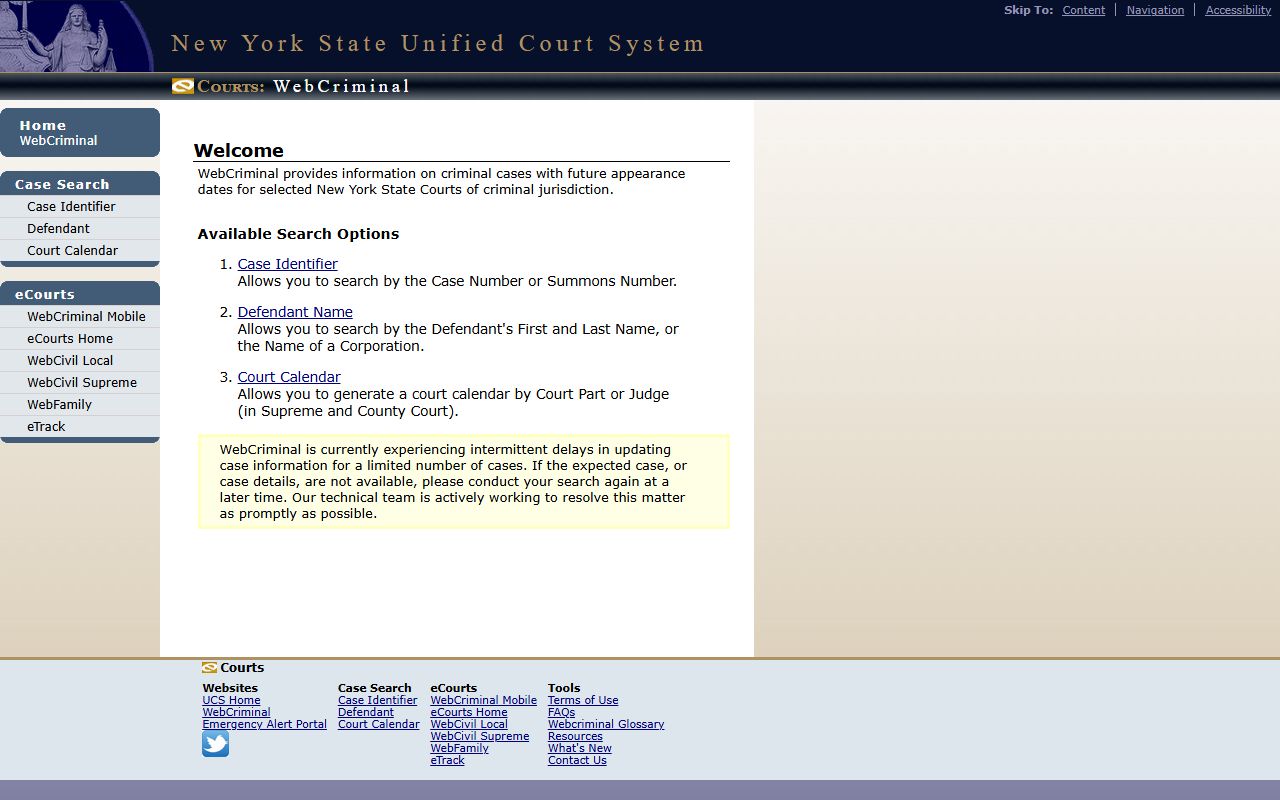
WebCriminal is most useful when a Niagara County arrest has produced an open public criminal case or future appearance.
Niagara Court Search Fields
The court search workflow differs from the jail roster. The roster starts with a Type to Search field over current custody cards. WebCriminal starts with a case identifier, defendant, or calendar route. SearchIQS, the County Clerk-linked records system, is a login or subscription route and should not be treated as the same free current criminal appearance lookup.
| Field Label | Type | Required | Notes |
|---|---|---|---|
| Case Identifier | Search path | One search mode | Use when a case, docket, summons, or identifier is known. |
| Defendant | Search path | One search mode | Use by name; portal workflow may require court or location choices. |
| Court Calendar | Search path | One search mode | Checks scheduled appearance or calendar data. |
| WebCriminal Mobile | Link | Optional | Mobile version linked from the portal. |
Charges Filed After Jail Arrest
New York CPL § 100.05 says a criminal action starts when an accusatory instrument is filed with a criminal court. After a Niagara County jail arrest, the court record may begin with a misdemeanor complaint, felony complaint, information, simplified information, prosecutor's information, indictment, or superior court information. The formal filing controls the court case. The jail roster is a custody record and may not match the final filed charge.
| Document | What It Does | Common Niagara County Use |
|---|---|---|
| Complaint | Accuses a person of an offense and starts or supports the case. | Often early local criminal court filing after arrest. |
| Information | Formal accusatory instrument that can prosecute certain offenses. | Used in local criminal court procedure. |
| Indictment | Grand jury felony charging document. | Serious felony cases that move to superior court. |
Niagara County Charge Status
Charge status can change after arrest. Pending means the case or charge has not reached final disposition. Amended or reduced means the prosecutor or court changed the charge. Dismissed means the charge or case ended without conviction. An indictment can replace or supersede an earlier felony complaint. A conviction is a plea or finding, not the same as being booked or accused.
| Status | What It Means |
|---|---|
| Pending | The court case or charge remains unresolved. |
| Amended / Reduced | The filed charge changed from the arrest or earlier court charge. |
| Dismissed | The charge ended without a conviction on that charge. |
| Indicted | A grand jury returned a superior-court charging document. |
| Convicted | A plea or finding established guilt on a charge. |
Niagara DA and Court Clerks
The Niagara County District Attorney is Brian D. Seaman. The official county DA page lists the DA office at the Niagara County Courthouse, 175 Hawley Street, 3rd Floor, Lockport, NY 14094-2740, phone (716) 439-7085. It also lists a Niagara Falls DA location at 1925 Main Street, Niagara Falls, NY 14305, phone (716) 286-4518. The DA prosecutes state and local criminal cases, but clerk offices maintain court files and public access counters.
Niagara County Court is at 175 Hawley Street, Lockport, NY 14094, with hours Monday-Friday, 9:00 a.m.-5:00 p.m., phone (716) 280-6400. The Niagara County Clerk page lists the courthouse address, phone (716) 439-7022, fax (716) 439-7035, and the email niagaracounty.clerk@niagaracounty.com. New York Courts help material also states that a CHRS criminal-history search costs $95.00 per search.
Bail Records After Arrest
New York CPL § 510.10 governs securing orders after a court appearance. A judge may release a person on recognizance, set non-monetary conditions, set bail, or remand the person when the law allows. Niagara County's sheriff menu links online bail payment to GovPayNet / AllPaid, but the court order controls release. A roster bail field may show N/A, and the latest court order may be different from the jail data.
| Release Term | Meaning |
|---|---|
| Release on recognizance | Release based on a promise to return to court. |
| Non-monetary conditions | Release with court conditions that are not cash bail. |
| Cash bail | Money set by court to secure return where legally allowed. |
| Remand | Court order holding the person without release. |
| Detainer or hold | Another agency or legal authority blocks release. |
Warrants and Court Records After Arrest
The Niagara County Sheriff's Office publishes an official Warrants page with Type to Search and paginated name cards. A warrant can lead to a jail booking when the person is arrested. The court record may then show the underlying case, appearance date, bench warrant history, or new charges. The sheriff warrant page did not confirm detailed fields such as charge, warrant number, issuing court, bond, or case number in the visible public text.
A person trying to clear a warrant should contact counsel or the issuing court. A person with an active warrant may be arrested if they appear at law enforcement. WebCriminal may show open criminal cases and future appearances, but it is not a complete warrant-clearing tool.
Charges vs Convictions
A Niagara County court record after an arrest may list charges before any conviction exists. The difference is critical. A charge is an accusation or custody basis. A conviction is a final plea or finding. Public jail and court systems can show charges that were later dismissed, reduced, or sealed. Do not treat a booking, mugshot, warrant card, or pending court charge as proof of guilt.
| Charge | Conviction | |
|---|---|---|
| Stage | Accusation or filed offense | Final plea or finding |
| Source | Roster, complaint, information, indictment, or court docket | Court disposition or sentence record |
| Can Change | Yes, charges can be amended or dismissed | Can be appealed, sealed, or otherwise limited by law |
Sealed and Restricted Records
New York is often a sealing state rather than a broad expungement state. CPL § 160.50 authorizes sealing after a criminal action terminates in the accused person's favor. CPL § 160.59 addresses sealing for certain older convictions. Sealed, youthful, confidential, and otherwise restricted cases may not appear in public court search tools. FOIL requests can also be denied or redacted when an exemption applies.
| Sealed | Expunged | |
|---|---|---|
| Public visibility | Generally hidden from public access | Destroyed or treated as removed where law allows |
| New York context | Common framework for favorable terminations and eligible old convictions | Less common and statute-specific |
| Practical effect | May restrict court records, photos, fingerprints, and related files | Depends on the specific legal authority |
Important: This site is not a consumer reporting agency, and public court data must not be used for FCRA-covered screening decisions.
Public Record Search
Sponsored Results